High-mileage buses rarely wear evenly. One engine may run mostly on open highways, while another spends its days idling in traffic and stopping every few blocks. Their filters face different demands. Dusty roads, long service hours, repeated cold starts, and heavy passenger loads can all affect how quickly air, fuel, oil, or hydraulic filters become restricted.
Why is custom filtration necessary for high-mileage buses? Because age and mileage alone do not describe a bus’s operating conditions. A practical filtration plan considers the engine and system specifications, route environment, maintenance records, and signs such as rising restriction or unusual contamination. It may involve selecting compatible filter media, checking housing fit, or adjusting inspection frequency. It should not mean installing an oversized or unapproved filter. That can create problems.
Good decisions rely on evidence. Technicians can review service history, inspect removed filters, monitor differential pressure where appropriate, and use oil analysis when it helps answer a specific question. A filter with visible dirt is not automatically at the end of its useful life, and a clean-looking one is not proof that everything is fine. Details matter. Changes should stay within the bus manufacturer’s requirements and be checked against real operating results. Customization is not a cure for worn components or skipped maintenance. Sometimes the original setup is still the right one. The useful question is whether the current filtration plan matches the bus’s actual work.
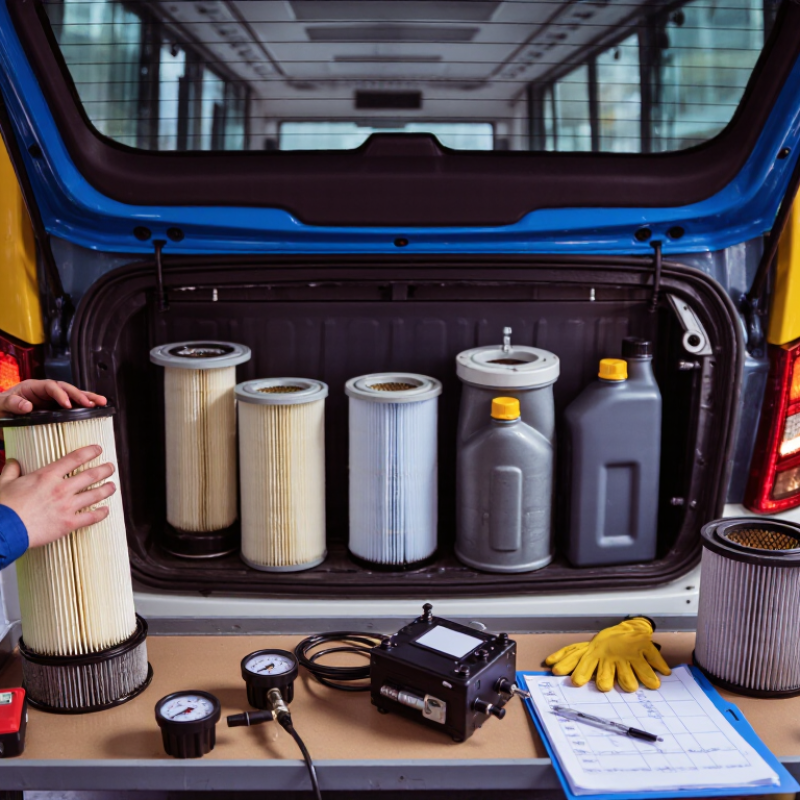
Custom filtration for a high-mileage bus starts with its duty cycle, not its odometer alone. A city bus idling at terminals and stopping every few blocks faces different demands from a highway coach running steady hours. Short trips can increase moisture and soot in engine oil, while dusty routes load air filters faster. These patterns help determine filter capacity, media, and inspection timing. Not the whole story.
Wear changes the picture. Aging seals or increased blow-by may add oil mist and soot to filtration circuits. Maintenance teams can compare oil analysis, restriction readings, and filter inspection notes across several service intervals before changing specifications. A dark filter alone proves little; it may show normal contaminant capture. Trends matter more than one observation, and they should be checked against service history.
Contaminant load varies with route, season, and maintenance condition. Fine road dust, soot, and moisture each place different demands on filtration. Choosing denser media without checking flow and pressure drop can create another problem: restricted flow. A practical plan records filter condition, operating hours, route type, and fluid test results. Some records will be incomplete. That uncertainty should be noted, not hidden, when setting inspection intervals.
Custom filtration for high-mileage buses begins with a circuit map, not a parts list. Trace intake air from the housing to the turbocharger, noting duct leaks and restriction indicators. Follow fuel from tank through water separator and fine filter to the injection system. Map oil flow through the pump, cooler, filter, and bypass valve; record pressure readings before choosing replacement media. Small details matter. EPA’s 2022 Heavy-Duty Engine and Vehicle Standards rule sets a 2027 nitrogen-oxide limit of 0.035 g/bhp-hr, down from 0.20 g/bhp-hr. That tighter emissions target makes clean, stable engine operation especially important (U.S. EPA, 2022).
Continue the map through coolant filters, where applicable, and hydraulic circuits serving lifts, steering, or other equipment. Note each filter’s location, flow direction, rated pressure, service interval, and any bypass or differential-pressure sensor. NREL’s Fleet DNA program publishes measured commercial-vehicle duty-cycle data; route, idle time, and stop frequency can all shape contamination and service needs. A bus working short urban loops may need a different inspection rhythm from one running steady highway routes. Use fluid samples and restriction readings alongside mileage, rather than treating mileage as the whole story. Maps can be wrong. I’ve seen neat diagrams miss a bypass line; verify the actual plumbing before specifying a custom element.
For high-mileage buses, an air filter must hold dust without creating excessive airflow restriction. ISO 5011:2020 provides a controlled way to compare heavy-duty filters. Its test procedure records initial restriction, dust-holding capacity, and filtration efficiency under specified airflow and dust-loading conditions. These are measured results, not universal ratings; compare filters tested at the same airflow and terminal restriction. Small differences matter.
A useful test report shows how restriction rises as dust accumulates, how much dust the element retains, and what fraction passes through. For example, a fleet engineer can compare the pressure-drop curve with the bus’s engine airflow requirements, rather than choosing by efficiency alone. ISO 5011:2020, Inlet air cleaning equipment for internal combustion engines and compressors—Performance testing, is the key reference for these measurements. Check the report’s test conditions and dust specification before drawing conclusions. That is useful.
Lab data has limits. Roadside dust, moisture, vibration, and imperfect sealing can change real-world performance, and a high dust-capacity result does not guarantee longer service life in every route. Inspect used elements and housings for uneven loading or bypass marks. A little humility helps: laboratory comparisons guide selection, but fleet maintenance records reveal what actually lasts.
Custom filtration means selecting or configuring an air-filter assembly for a bus’s engine, air-intake layout, operating environment, and maintenance requirements. ISO 5011 provides standardized methods for evaluating air-cleaner performance, including restriction, filtration efficiency, and dust-holding capacity. The comparisons below describe common design trade-offs; they are not measured results for specific products.
| Filter configuration | Typical construction | Dust-loading behavior | Restriction considerations | Potential bus application | What to compare in an ISO 5011 report |
|---|---|---|---|---|---|
| Single-stage cellulose element | Pleated cellulose-based media in a sealed housing. | Dust is captured in and on the media; service life depends on media area, dust concentration, and operating conditions. | Restriction rises as dust accumulates. A larger media area can help manage airflow, subject to housing and engine requirements. | Routes with moderate dust exposure and established scheduled maintenance. | Initial restriction, efficiency over the test, dust capacity at the defined terminal restriction, and leakage or sealing details. |
| Synthetic-media element | Pleated synthetic fibers; media structure and surface treatments vary by design. | Loading characteristics depend on fiber structure, pleat geometry, and the test dust; media type alone does not establish capacity. | Compare measured restriction at the same airflow and test conditions rather than assuming lower restriction from material type. | Applications where a synthetic element is specified and compatibility with the existing housing is verified. | Test airflow, dust type and feed, efficiency, pressure-drop curve, terminal restriction, and reported dust capacity. |
| Two-stage system with pre-cleaner | A particle-separation stage ahead of a primary filter; designs may use inertial or other separation methods. | The pre-cleaner can separate some incoming dust before it reaches the primary element. Effectiveness varies with design and operating conditions. | Assess the complete assembly: added components can affect total restriction, while reduced primary-filter loading may be beneficial in dusty service. | Routes with frequent dust exposure, provided the assembly fits the intake system and can be maintained correctly. | Whether results are for the full assembly or a component, overall restriction, downstream efficiency, and dust capacity under the stated test setup. |
| Primary element with safety element | A primary filter plus a secondary element intended to provide added protection during primary-element servicing or failure, depending on system design. | The safety element is not a substitute for timely primary-filter maintenance; its role and service procedure should follow the equipment specification. | Measure restriction with the complete intended configuration, since an additional element may change system airflow resistance. | Fleets seeking an extra safeguard during servicing, where the engine and air-cleaner manufacturer allow this arrangement. | Configuration tested, initial and loaded restriction, efficiency, and whether the safety element was installed during the test. |
| Custom-sized or application-specific assembly | An element, seals, or housing adapted to the available installation space and required airflow. | Performance depends on the complete design, including media area, seal integrity, dust distribution, and service access. | Confirm the required engine airflow and allowable restriction with the vehicle or engine documentation; validate the final assembly by testing. | High-mileage buses with a documented fitment, operating, or maintenance requirement that standard configurations do not address. | A report for the finished configuration, with identified test conditions, airflow, restriction, efficiency, dust capacity, and sealing arrangement. |
Comparison note: ISO 5011 results are meaningful when the tested airflow, dust, terminal restriction, test configuration, and reporting basis are stated and comparable. Do not treat a filter-media category as a guaranteed efficiency or service-life rating. Select a replacement that meets the vehicle or engine requirements, seals correctly, and is supported by test data for the relevant assembly.
For a high-mileage bus, custom filtration means selecting a hydraulic filter for the system’s actual flow, fluid, temperature, and contamination risks—not simply matching a housing. A useful performance specification is ISO 16889:2022, the multipass test method for hydraulic filter elements. Under this test, βx(c)=200 means that, at the stated particle size x(c), 200 particles enter for every one that passes through. That is 99.5% efficiency at that size under test conditions. A strong number. But it is not a promise of identical performance in every bus.
Real service conditions matter. A cold morning can thicken oil and raise pressure drop; worn cylinders or frequent steering cycles can add contamination. Specify the particle size alongside the beta ratio, then check rated flow, dirt-holding capacity, and bypass-valve settings. ISO 16889 provides the test basis, while ISO 4406 can help describe fluid cleanliness using particle counts. These standards make comparisons clearer, though maintenance records and oil analysis still reveal what the vehicle actually needs.
Tips:
Plan Filter Changes Using OEM Limits, Pressure Drop, and Oil Analysis
For a high-mileage bus, custom filtration means adjusting service decisions to real operating conditions, not simply installing a finer filter. Start with the engine maker’s service limits and approved filter specifications. Then record mileage, engine hours, route type, and dust exposure. A bus idling through city traffic faces a different load than one covering long highway runs.
Check pressure drop under comparable operating conditions. A rising reading may point to a loaded element, but sensor faults or changing oil temperature can mislead. Don’t extend an interval based on one measurement. Compare trends, and replace the filter before reaching the stated restriction limit. Keep a clear record of each reading.
Oil analysis adds another useful signal. Track wear metals, soot, fuel dilution, and viscosity across samples taken consistently. These results describe oil condition, not filter condition by themselves. The evidence can disagree. That’s normal, and worth investigating rather than smoothing over. Review unusual results with a qualified technician, inspect for leaks or abnormal wear, and stay within OEM limits while the cause remains uncertain. A little caution costs less than guessing wrong.
City buses idle and stop often, while highway coaches run more steadily. Those patterns affect soot, moisture, and filter loading. Mileage alone misses that.
Short trips may increase moisture and soot in the oil. Dusty routes can load air filters faster. Route details matter.
Aging seals or increased blow-by can add oil mist and soot. Compare oil tests, restriction readings, and inspection notes over several service intervals. One reading may mislead.
Not by itself. A dark filter may simply be capturing normal contaminants. Check its condition against service history and other readings.
At the stated particle size, 200 particles enter for every one that passes through. That equals 99.5% efficiency at that size under test conditions. Not a field guarantee.
Match the filter to system flow, fluid, temperature, and contamination risks. Also check particle size, dirt-holding capacity, and bypass-valve settings. A housing match is not enough.
Cold oil can be thicker and raise pressure drop. Check rated flow under cold-start conditions, not only when the system is warm. Easy to overlook.
Track operating hours, route type, filter condition, and fluid test results. Adjust intervals using trends across service visits. Some records will be incomplete.
It describes fluid cleanliness through particle counts, making results easier to compare. Pair those counts with oil analysis and vehicle history. Numbers need context.
Custom filtration for high-mileage buses begins with understanding how each vehicle is used. Daily distance, stop-and-go traffic, dusty routes, temperature changes, component wear, and contaminant exposure all affect filtration needs. Why is custom filtration necessary for high-mileage buses? Because aging systems and demanding duty cycles can place different loads on air, fuel, oil, coolant, and hydraulic circuits. Mapping these circuits helps identify the right filter function and performance requirements for each one.
Heavy-duty air filters can be compared through ISO 5011 dust-loading tests, which assess dust capacity and restriction under controlled conditions. For hydraulic filters, ISO 16889 efficiency ratings provide a useful comparison: βₓ(c)=200 indicates that the filter captures about 99.5% of particles at the specified size. Replacement intervals should reflect OEM limits, pressure-drop readings, operating conditions, and oil-analysis results—not mileage alone. This approach supports consistent protection while avoiding premature changes or excessive restriction.

Tolev Auto