Customizable automotive filtration is moving beyond the idea of a single “best” filter. Vehicle makers, fleet operators, and drivers increasingly need filtration suited to different engines, cabin environments, climates, and service schedules. What are the latest trends in customizable automotive filtration? This overview examines ten developments shaping that shift, from modular filter designs and specialized media to sensor-supported maintenance and improved cabin air solutions.
A composite expert perspective, represented here by filtration engineer Sara Lin, puts the challenge plainly: “Customization matters only when the filter fits the vehicle, the operating conditions, and the evidence.” This is an editorially created quote, not a verbatim statement from a named real-world expert. The distinction matters. Product claims should be checked against test data, fitment requirements, and manufacturer guidance—not attractive packaging alone.
The trends ahead include application-specific filter media, configurable housings, filtration for electric-vehicle cabins, and materials designed with reuse or lower waste in mind. Digital tools may also help predict replacement needs by tracking dust, mileage, or operating conditions. Small details count: a dusty delivery route, repeated short trips, or a tightly packaged engine bay can change what a practical filter needs to do. Yet customization is not automatically an upgrade. More options can complicate maintenance, and a sensor cannot replace sound testing. This outline explores the promise, limits, and real-world trade-offs behind the latest designs.
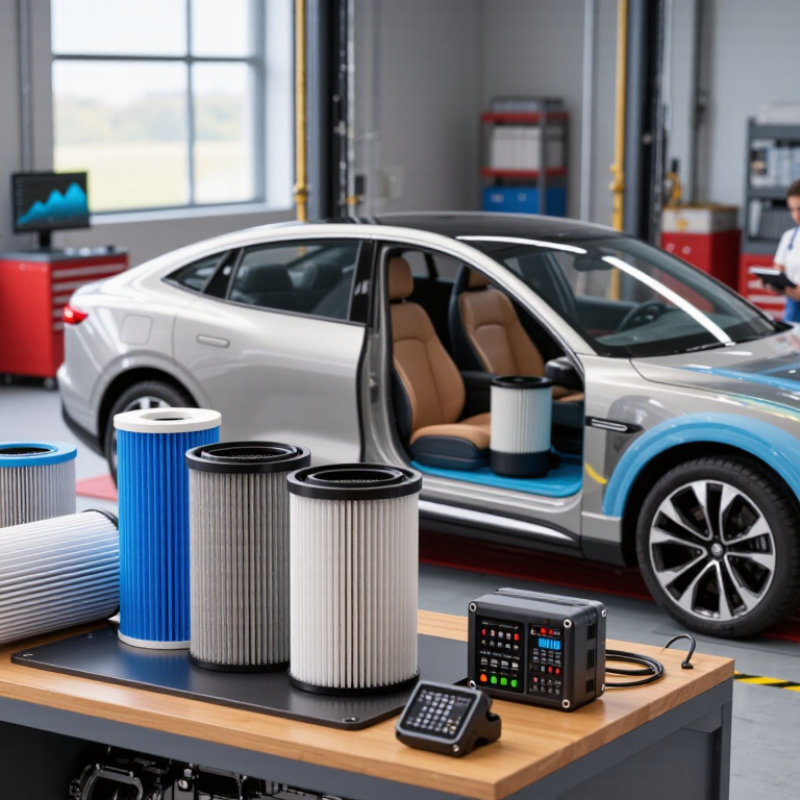
Customizable automotive filtration means tuning filter media, size, and airflow resistance to a vehicle’s operating conditions. Cabin filters capture dust, pollen, and other airborne particles; engine intake filters keep abrasive debris away from engine components. Oil and fuel filters perform separate jobs inside their respective systems. The details matter. A filter that traps finer particles may also restrict airflow sooner, so filtration efficiency and service life need to be considered together.
The U.S. EPA’s 2024 Automotive Trends Report recorded average new-vehicle fuel economy of 27.1 miles per gallon for model year 2023. This is fleet-wide context, not evidence that a particular filter improves fuel economy. The World Health Organization’s 2022 air-quality update reported that 99% of the global population breathed air exceeding its recommended limits. For cabin filtration, that makes particle capture relevant, though performance depends on the filter, housing, and installation.
Customization can account for dusty roads, frequent stop-and-go driving, humid climates, or a driver’s sensitivity to airborne particles. In practice, I’d check the specified fit, pressure drop, and replacement interval before choosing denser media. A poorly seated filter can let air bypass it. There is a trade-off. Fine filtration is useful, but it is not automatically better if airflow or timely maintenance suffers. I would be cautious about any claim that one filter suits every vehicle and driving environment.
Advanced materials are changing how automotive filters handle dust, moisture, and fine particles. Layered media can combine coarse fibers for larger debris with finer fibers that capture smaller contaminants. Some designs also use activated carbon to reduce odors. The right combination depends on the vehicle, driving conditions, and airflow requirements.
Modular designs make customization more practical. A filter may use a reusable frame with replaceable media, or separate layers that can be serviced individually. For a technician, clear labels and a firm gasket matter as much as the media itself. A slight gap around the edge can let unfiltered air pass through. Fit matters.
Custom options should be tested for pressure drop, filtration efficiency, and durability across temperature and humidity changes. A denser layer may capture more particles, but it can also restrict airflow sooner. That trade-off is easy to underestimate. Not always. Materials that perform well in a clean test environment may behave differently after weeks of road dust and vibration. Designers still need to balance serviceability, cost, and reliable fit, rather than treating advanced materials as a solution on their own.
| No. | Trend | How It Works | Customization Opportunity | Key Consideration |
|---|---|---|---|---|
| 1 | Multilayer synthetic filter media | Different nonwoven layers can be designed to capture particles of varying sizes while maintaining airflow. Synthetic media can also offer moisture resistance compared with some traditional cellulose-based media. | Layer structure, media area, pleat depth, and filtration efficiency can be selected for the vehicle’s intake or cabin-air requirements. | Efficiency, airflow restriction, dust-holding capacity, and service life need to be evaluated together. |
| 2 | Nanofiber surface layers | Fine fibers applied as a surface layer can help capture small airborne particles without requiring the entire filter medium to be made from extremely fine fibers. | Surface-layer characteristics can be tailored for particulate capture, pressure drop, and the intended engine or cabin application. | Performance depends on the complete filter design, including media support, sealing, and operating airflow. |
| 3 | Electret filtration media | Electret media use persistent electrostatic charges to attract particles, allowing particle capture in addition to mechanical filtration. | Charge level and media construction can be selected to balance particle efficiency and airflow in cabin or engine-intake filters. | Dust loading, humidity, and test conditions can affect measured performance; specifications should state the test method. |
| 4 | Combination cabin-air media | Cabin filters can combine particle-filtering layers with activated carbon, which adsorbs certain gases and odors. | Designs can prioritize particles, selected gaseous pollutants, odor reduction, or a combination of these functions. | Activated carbon capacity is finite, and a carbon layer does not remove every gaseous pollutant. |
| 5 | Higher-efficiency cabin filtration | More efficient cabin filters are designed to capture a greater share of fine airborne particles, subject to the filter’s construction and the vehicle’s HVAC system. | Filter efficiency and dimensions can be matched to available housing space and the desired balance between particle capture and ventilation. | Higher restriction can affect airflow; fit, sealing, and HVAC compatibility remain essential. |
| 6 | Modular filter housings | Multi-piece or modular housings separate components such as the frame, media, seals, and access features to support different configurations. | A shared housing concept can accommodate different media grades, vehicle trims, or service requirements through interchangeable components. | Modules must seal reliably and withstand vibration, temperature variation, and under-hood or cabin conditions. |
| 7 | Application-specific pleat geometry | Pleat height, spacing, and shape influence the available filtration area and how air is distributed through the media. | Geometry can be adapted to the filter envelope, airflow target, dust capacity, and installation orientation of a specific vehicle. | Poorly supported or uneven pleats can deform and reduce effective filtration area. |
| 8 | Condition-based filter monitoring | Some vehicle systems can use pressure or airflow measurements to help estimate filter loading; diagnostic signals may also be used in maintenance strategies. | Monitoring thresholds and service alerts can be tuned to an application when suitable sensors and vehicle controls are available. | Sensor readings are indirect indicators and should be validated against operating conditions and maintenance requirements. |
| 9 | Recycled and bio-based material options | Filter frames, packaging, or selected media components may use recycled or renewable-source materials where performance and manufacturing requirements permit. | Material choices can be adjusted to meet design goals for resource use, recyclability, weight, and component durability. | Material origin alone does not establish environmental impact; durability, production, and end-of-life pathways also matter. |
| 10 | Precision-designed frames and seals | Improved dimensional control and application-specific sealing help reduce bypass airflow around the filter, where unfiltered air could otherwise pass through gaps. | Frame profiles, gasket materials, and tolerances can be customized to the filter housing and vehicle packaging constraints. | Correct fit and installation are critical; a high-efficiency medium cannot compensate for leakage around the filter. |
Smart sensors are making automotive filtration more responsive to real driving conditions. A pressure sensor across a filter can detect rising restriction; temperature and humidity readings add useful context. The control system can then adjust airflow or flag a filter for inspection, rather than relying only on a fixed service interval. In city traffic, that may mean reacting to repeated dusty routes. On a cold, damp morning, readings may need a different interpretation. Small details matter.
The potential is practical, but not automatic. McKinsey’s 2018 manufacturing analytics report estimates predictive maintenance can reduce maintenance costs by 10–40% and downtime by 30–50%. Deloitte’s 2023 Smart Manufacturing Survey found 86% of respondents expected smart manufacturing to be a major competitiveness driver within five years. These figures cover broader manufacturing, not automotive filters specifically. Still, they show why adaptive systems attract investment. A sensor can be wrong. Poor placement, drift, or a clogged sensing port can trigger needless alerts. Systems should compare pressure trends with operating time and environmental conditions, and technicians should verify unusual readings. There is room to improve: filter loading is not always captured by one measurement, especially when dust, moisture, and airflow change together.
Custom filtration starts with the vehicle, not a universal size chart. S&P Global Mobility reported that the average age of U.S. light vehicles reached 12.6 years in 2024. That aging fleet spans different engine layouts, housings, and service histories. For intake filters, match the panel shape, sealing edge, and airflow requirement to the exact model and engine. A filter that fits loosely can let dust bypass the media. Fit matters.
Oil and fuel filters also need vehicle-specific attention. Confirm thread, gasket, pressure rating, and media compatibility before changing specifications. Diesel systems, direct-injection engines, and older vehicles may require different filtration details. Electric vehicles remove engine oil and fuel filters from the maintenance list, but not cabin filtration. The IEA’s Global EV Outlook 2024 projected nearly 17 million electric-car sales that year, more than one in five new cars worldwide. The product mix is changing.
Cabin filters show why local conditions matter. The World Health Organization reported that 99% of the global population lived in places exceeding its air-quality guideline levels. Dust, pollen, and dense traffic can make filter choice especially noticeable. Consider media efficiency alongside airflow, dimensions, and replacement access; higher resistance is not automatically better. Test the exact assembly when possible. Real-world dust loads differ, and published ratings alone cannot predict every cabin’s performance.
Customizable Automotive Filtration: Performance Standards, Market Drivers, and Emerging Innovations
Filter design is shifting from one-size-fits-all parts toward media tailored to vehicle use, climate, and maintenance needs. Performance still needs measurable proof. ISO 5011 defines test methods for engine intake air cleaners, while ISO 11155 covers cabin air filters. These standards help compare pressure drop, particle capture, and service behavior under controlled conditions. Real roads are less predictable.
Electrification is changing the brief. The International Energy Agency’s Global EV Outlook 2024 reported that electric car sales reached nearly 14 million in 2023, about 18% of new car sales. More electric vehicles mean less demand for conventional engine intake filtration, but cabin filtration and battery thermal-management needs remain important. Dusty roads, wildfire smoke, and longer service intervals also push buyers toward filters designed for specific operating conditions. Small details matter: a poorly sealed edge can let particles bypass efficient media.
Newer designs use layered media, electrostatic capture, and sensor-informed maintenance alerts. Some systems can be adapted for different airflow or particle targets, though added filtration may increase resistance and energy use. That trade-off deserves more attention. A higher capture rating alone does not prove better performance across a vehicle’s full service life. Manufacturers and fleet operators should compare standardized test results with field data, replacement frequency, and fit. Customization is useful, but not automatically superior.
Performance standards, market drivers, and emerging innovations
Regulatory driver: Euro 7 sets brake-particle emission limits of 3 mg/km for pure electric vehicles and 7 mg/km for other powertrains in the applicable vehicle categories. These limits strengthen demand for particulate-control solutions, including improved filtration and dust-containment designs. Other customization trends include application-specific media, multilayer filter structures, lower pressure drop, compact packaging, sensor-based monitoring, and materials designed for durability and recyclability.
Source: Regulation (EU) 2024/1257 (Euro 7). Values shown are regulatory limits, not company or brand data.
It means adjusting filter media, size, and airflow resistance to suit a vehicle’s use. A dusty commute may need different choices.
Cabin filters capture particles such as dust and pollen. Engine intake filters help keep abrasive debris away from engine components. Oil and fuel filters serve separate systems.
It may capture finer particles, but it can also restrict airflow sooner. More filtration is not always better.
Check the specified fit, pressure drop, and replacement interval. A loose edge can let unfiltered air bypass the media. Fit matters.
Layered media can capture particles of different sizes, while activated carbon may reduce odors. The best combination depends on airflow needs and driving conditions.
Some designs have reusable frames or replaceable media layers. Clear labels and a firm gasket still matter during installation.
Standardized methods compare factors such as particle capture and pressure drop. Road dust, vibration, heat, and humidity can change real-world performance.
They need less conventional engine intake filtration, but cabin and battery thermal-management filtration remain relevant. I may be underestimating how much conditions vary.
No. A filter can capture more particles yet restrict airflow or need earlier replacement. Compare test results with fit and field use.
Customizable automotive filtration is evolving from one-size-fits-all components into systems tailored to vehicle design, driving conditions, and maintenance needs. Advanced filter media can balance airflow, particle capture, durability, and resistance to heat or moisture, while modular designs make it easier to adapt or replace individual components. Smart sensors and adaptive technologies are also gaining attention, helping monitor filter condition and adjust filtration performance as operating conditions change.
What are the latest trends in customizable automotive filtration? Key developments include vehicle-specific configurations for engine air, oil, fuel, and cabin filters, along with improved materials and integrated monitoring. These innovations aim to support efficient operation, cleaner cabin air, and more predictable servicing. At the same time, performance standards and demand for better efficiency, durability, and environmental outcomes are shaping the market. Emerging research continues to explore connected filtration, recyclable materials, and designs that can be configured for different vehicle platforms and use cases.

Tolev Auto