Why do electric vehicles still need specialized air filters? The question sounds odd when a car has no tailpipe. Yet an EV still draws air through its heating, ventilation, and air-conditioning system, carrying pollen, road dust, soot, and other particles into the cabin. Some models also use filters to protect specific cooling or electronics systems; designs vary, so not every EV has the same filtration needs. Indoor-air-quality researcher Dr. Richard Corsi has emphasized a related principle: “The more air changes per hour, the better.” In a vehicle, however, airflow must work alongside effective filtration. More airflow alone does not guarantee cleaner air.
This guide explores ten practical reasons EV filters matter, from passenger comfort to protecting HVAC components from accumulated debris. A filter can capture particles, but its performance depends on its design, condition, and fit. It cannot remove every gas or solve every air-quality issue. That distinction is easy to miss. EVs may reduce brake wear through regenerative braking, yet tires still meet pavement, and busy roads remain dusty. A clogged cabin filter can also restrict airflow, making a drive feel stuffy on a rainy morning or during a hot commute. The details are less dramatic than battery range, but they deserve attention. Some claims about “advanced” filters need careful checking, too. Here, we look at what specialized filtration can realistically do—and where its limits begin.
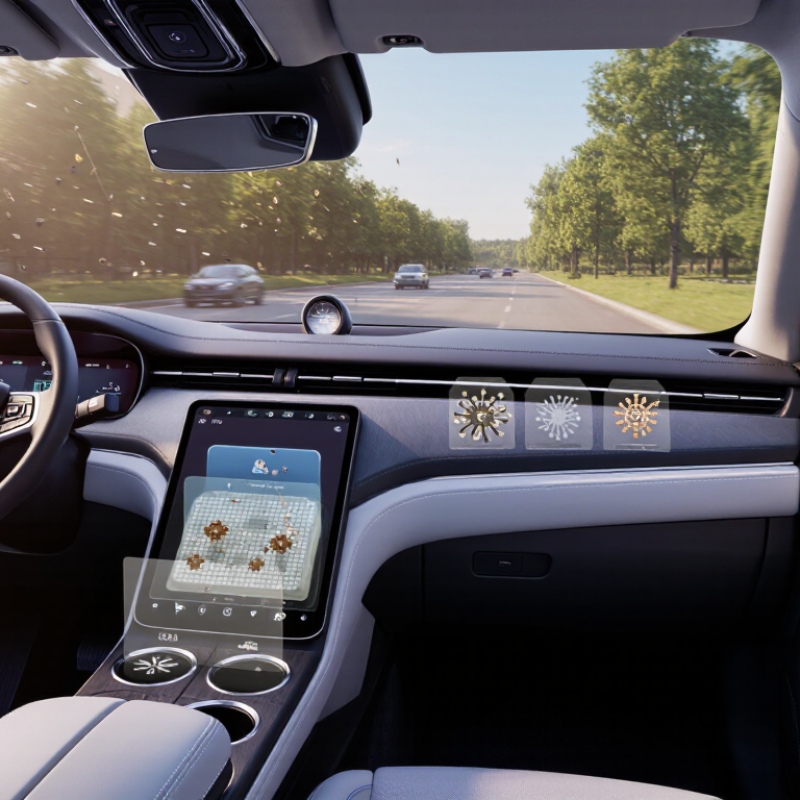
The WHO’s 2021 air quality guidelines recommend an annual mean PM2.5 concentration of 5 μg/m³. This is a long-term, population-level guideline, not a pass-or-fail limit for one drive. Still, it offers a useful reference point for thinking about cabin air. Fine particles can enter through the ventilation intake, open doors, and gaps around seals. Traffic adds a changing mix of combustion particles, road dust, and brake and tire wear. Often, none of it is visible. That matters.
An electric drivetrain does not prevent polluted outdoor air from entering the cabin. A well-fitted filter designed to capture fine particles can reduce some exposure, but performance depends on its materials, fit, airflow, and condition. Recirculation may reduce incoming particles temporarily, but it is not a complete solution for every cabin condition. Check independent test information, the correct filter dimensions, and replacement guidance instead of relying on vague clean-air claims. The details are easy to overlook. The WHO figure also cannot prove that a specific vehicle or filter makes cabin air safe; real-world levels vary with traffic, weather, and ventilation settings.
Cabin-Air Risks: WHO’s 2021 annual PM2.5 guideline is 5 μg/m³.
| # | Reason | Evidence and data | What it means for EV cabin filtration |
|---|---|---|---|
| 1 | WHO’s low PM2.5 guideline highlights the need to limit exposure | The WHO 2021 Air Quality Guidelines recommend an annual mean PM2.5 level of 5 μg/m³ and a 24-hour mean of 15 μg/m³. These are ambient-air guideline levels, not vehicle-cabin standards. [1] | A filter specification should state its particle-filtration performance and test conditions rather than relying on a general “clean air” claim. |
| 2 | Fine particles can reach deep into the respiratory system | PM2.5 consists of particles 2.5 micrometres or smaller. WHO notes that fine particulate matter can penetrate deep into the lungs and enter the bloodstream. [2] | Particle filtration is a core cabin-air function; performance should be evaluated for fine particles as well as larger visible dust. |
| 3 | Roadside air can enter through the ventilation system | When a vehicle draws in outside air, the HVAC intake is a potential route for outdoor particles and gases to enter the cabin. The amount and type of pollution vary with location and conditions. | Filter fit, intake design and filtration performance at the HVAC system’s operating airflow all matter—not just the filter’s material description. |
| 4 | Particles and gases require different filtration approaches | A particulate filter is designed to capture particles; it does not automatically remove gases such as nitrogen dioxide or many volatile organic compounds. ISO 11155-1 covers particulate filtration testing, while ISO 11155-2 covers gas-adsorption testing. [3] | Where gas reduction is needed, look for a gas-adsorbing filter layer and test data for the relevant gases, in addition to particle-filtration data. |
| 5 | Electrification does not eliminate non-exhaust road particles | Road traffic produces non-exhaust particulate emissions, including particles associated with tyres, brakes and road-surface wear. These sources are distinct from tailpipe exhaust. [4] | Even without a tailpipe, an EV cabin can still benefit from effective particle filtration. The airborne share and cabin exposure depend on conditions. |
| 6 | Pollen and other airborne biological particles can enter the cabin | Pollen and fungal spores are airborne particles. A cabin filter’s ability to capture them depends on its construction, particle size and operating conditions. | If allergen reduction is a priority, choose a filter with documented particle-capture performance for the relevant size range rather than assuming all cabin filters perform alike. |
| 7 | Filtration must work at real HVAC airflow | Air-filter performance is assessed under defined test conditions. Filter efficiency and airflow resistance are separate characteristics; a result measured at one airflow does not describe every operating condition. [3] | Compare efficiency and pressure-drop data at stated test conditions, and ensure the filter is suitable for the vehicle’s HVAC system. |
| 8 | A poor fit can allow air to bypass the filter | Filtration only applies to air that passes through the filter media. Gaps around an incorrectly sized or installed filter can provide a route for unfiltered air. | Vehicle-specific dimensions, correct installation and a well-sealed housing are important parts of cabin filtration performance. |
| 9 | Recirculation changes outdoor-air intake but is not a complete solution | Recirculation reduces the share of newly drawn outdoor air, while fresh-air mode brings outside air into the ventilation system. Neither mode makes a filter’s performance irrelevant. | A suitable filter can help treat air passing through the system in either mode. Ventilation settings should still be used in accordance with vehicle guidance and driving conditions. |
| 10 | Filter condition affects ongoing performance | Dust accumulation can increase airflow resistance and reduce ventilation performance. Service intervals vary with vehicle design, use and environmental conditions. | Follow the vehicle’s maintenance guidance, inspect or replace the filter as specified, and do not assume one universal replacement interval applies to every EV. |
Note: EVs do not inherently require a wholly different filter technology from other vehicles. “Specialized” filtration means selecting a correctly fitting filter whose tested particle and, where applicable, gas performance suits the vehicle’s HVAC system and expected cabin-air risks.
It is an annual population-level reference, not a pass-or-fail limit for one drive. One trip cannot settle the question.
No. Particles can enter through ventilation, open doors, and gaps around seals. Electric drive does not stop them.
A well-fitted filter designed for fine particles can reduce some exposure. Results depend on its material, fit, airflow, and condition.
It may temporarily reduce incoming particles, but it is not a complete solution. Cabin conditions still vary.
Check independent test results, correct dimensions, and replacement guidance. Broad clean-air claims alone reveal little.
It assesses particle filtration and airflow resistance under controlled conditions. Small details count.
Higher particle capture can bring greater airflow resistance. Less air may reach the cabin at the same fan setting.
No. Traffic, weather, installation, filter condition, and vehicle airflow can change results. A lab test is useful, but incomplete.
Why do electric vehicles still need specialized air filters? Because a quiet, efficient cabin depends on more than keeping dust out. Fine particles can enter through ventilation, and the WHO’s 2021 annual guideline for PM2.5 is 5 μg/m³, underscoring the value of effective cabin filtration. A well-matched filter helps capture airborne particles while preserving the airflow the heating and cooling system needs.
EV filters also have to balance comfort, energy use, and air quality. Heating can draw substantial power: AAA measured a 41% driving-range reduction at 20°F when cabin heat was used. Filter performance should therefore be assessed for both particle capture and airflow, using test measures defined by ISO 11155-1. Activated carbon can complement particle media by helping reduce odors and some gaseous compounds, including VOCs. Finally, correct fit, suitable service life, and compatibility with the vehicle’s HVAC specifications and sensors help maintain reliable performance over time.

 Tolev Auto